Anteriora

For product founders · desktop app

Find what came before.

Before you file, name or build, Anteriora looks back for you: a prior-art survey of your invention, a read of your document or repository into draft matters, and a name check against the US and French trademark registers (EU, Madrid and other countries not searched). The assistant runs in a hardware-isolated machine that your computer verifies before a word is sent.

  • macOS and Ubuntu
  • Verified before sending
  • Verifiable record
The app's own screens beside a diagram of the check: this computer verifies the sealed machine (hardware, signed software identity), sends the matter sealed to it, then shows the session's checks, the ranked list of earlier patents, and a record that checked out.
Real screens from the app, captured 22 Oct 2026 (cropped, panned and edge-faded, nothing redrawn), beside an animated diagram of the check. Silent loop, 12 seconds.

Three jobs

One app. Three questions a founder asks before launching.

Prior-art survey

Describe an invention. The assistant searches about 29.6 million US, European and WIPO patent publications through a sealed search machine your computer checks first. You get the closest earlier patents, your own relevance marks, and a record anyone can verify.

Titles and abstracts, to mid-April 2026. Patents only: not papers, code, other offices or full text.

What it covers, and what it does not

Read a document or a repository

Point it at a document, a folder, a git link or a GitHub repository. It lists each distinct invention it finds and writes a draft matter for each. You choose what it reads; test code can be left out.

Measured: a 1,700-line repository took about 40 minutes and produced 12 drafts. A draft is a starting point, not a filing.

How the read works

Name check

List the names you are considering. The search runs on your computer, in a local copy of the US (USPTO) and French (INPI) registers. A name is never sent to a trademark register, a search engine or a website. The report lists registered marks that resemble each name, and why.

5,741,201 live word marks; US to 30 Sep 2026, France to 16 Oct 2026. Not searched: EU marks (EUIPO), WIPO Madrid, other countries, company names, domains, logos.

Coverage and the report

How the privacy works

Your computer verifies the machine before a word is sent.

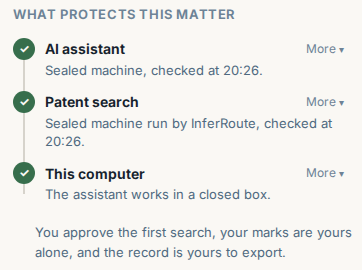
You have to describe the invention to search for it. So the assistant runs in a hardware-isolated machine (confidential computing). Before any of your text is sent, the app verifies that machine by remote attestation: its hardware, and that its software matches the identity InferRoute signed and published. If a check fails, nothing is sent.

  • Your description is sealed on your computer to the machine it just verified. InferRoute's relay carries it without being able to read it.
  • Every session shows what was checked, and what the check cannot prove.
  • You can export a record of a session's searches and check it with the verifier that ships in it, without trusting InferRoute.

An NDA is a promise; this is a check your computer runs. Technical confidentiality, not a legal NDA.

What the check proves, and what it cannot
The “What protects this matter” panel, shown in every session: the assistant's machine and the patent search, each verified by remote attestation before any text leaves this computer. Real screenshot (detail), 21 Oct 2026. Tap to enlarge.

Verify first. Then send.

Illustration of the check the app runs, every session, before a word is sent

  1. Your computeryour description, held in a matter
  2. Hardware signaturethe chip maker’s signature checks out
  3. Software identitymatches what InferRoute signed and published
  4. Sealedon your computer, to the verified machine
  5. Then sentif a check fails, nothing is sent

Built on

  • Confidential computinghardware-isolated machines
  • Intel TDX · NVIDIA confidential GPUsthe AI assistant
  • AMD SEV-SNPthe patent search
  • Remote attestationa hardware-signed report, checked on your computer
  • Signed software identitypublished by InferRoute
  • Sealed to the verified machinesealed on your computer; our relay cannot read it

Stated plainly

What each job covers, and does not.

Prior-art survey

Searched

  • About 29.6 million US, EP and WO patent publications
  • Titles and abstracts
  • Up to mid-April 2026 (US to 21 Apr, EP to 15 Apr, WO to 9 Apr)

Not searched

  • Full text, claims or descriptions
  • French national patents; CN, JP, KR, DE or other offices
  • Papers, open-source code, other non-patent literature
  • Anything after mid-April 2026

It gives no answer on novelty or freedom to operate. That is a question for a patent attorney.

Read a document or a repository

It does

  • Read a document, a folder, a git link or a GitHub repository (read-only access, only to the repositories you choose; the repository is copied to your computer and read there)
  • List each distinct invention it finds
  • Write one draft matter per invention
  • Let you choose what it reads; test code can be left out

It does not

  • Promise to find every invention
  • Say whether anything is patentable
  • Produce something ready to file

Name check

Searched, on your computer

  • USPTO (United States) and INPI (France)
  • Live word marks only: 5,741,201
  • US to 30 Sep 2026 (including the 212,789 Madrid registrations designating the US); France to 16 Oct 2026, national filings only

Not searched

  • EU trade marks (EUIPO); WIPO Madrid registrations designating France or the EU
  • Other countries
  • Company and trading names, domain names, unregistered use
  • Logo-only marks; expired or dead marks

It never says a name is free to use or can be registered, and it does not judge whether two marks would be confused. Not legal advice.

The record

A record you can hand to anyone.

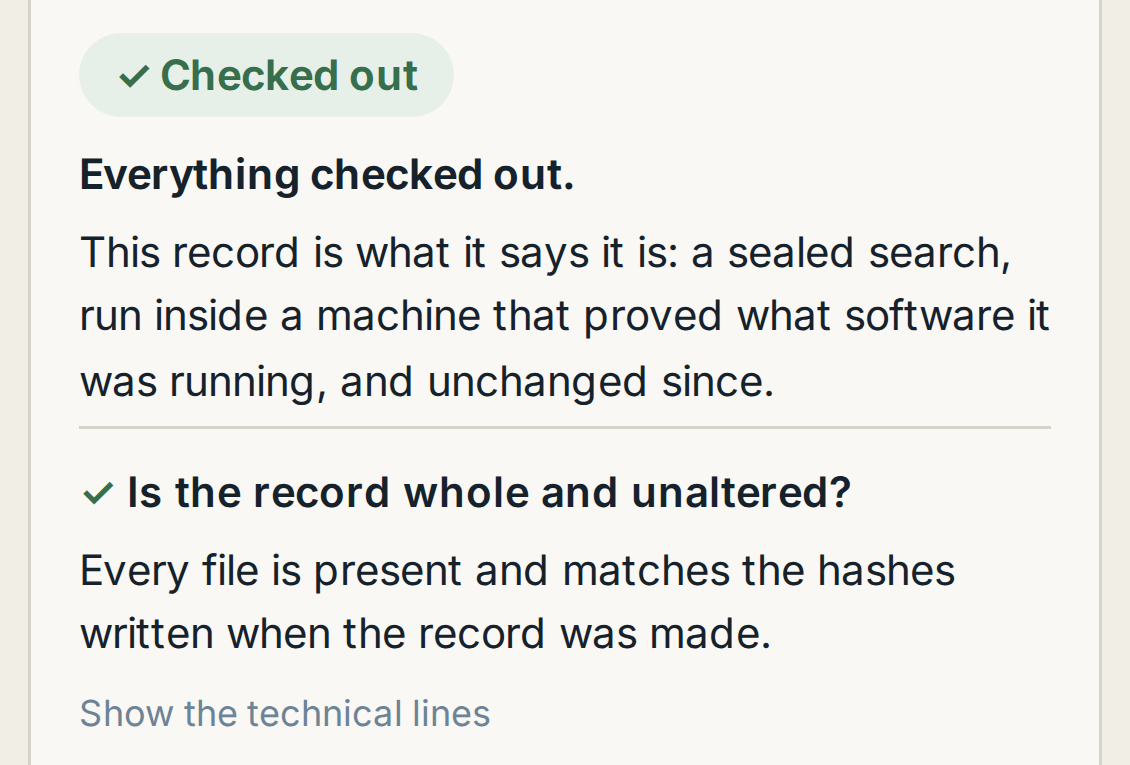
At the end of a session you can export a record of its searches. It ships with its own verifier, so your attorney, your co-founder or an investor can check it without trusting InferRoute.

What a record shows is what was searched and what came back. It is not a filing, and it does not establish when you invented something.

A record checked in the app: everything checked out, then the first of the questions the check answers. Real screenshot (detail), 22 Oct 2026. Tap to enlarge.

For patent and trademark professionals

A first look at a client's invention, before anything is filed.

Run a first prior-art survey or name check on a client's matter, before a filing exists.

Checked before anything is sent

Your computer verifies the sealed machine first. If the check fails, nothing is sent.

A record your client can check

The searches and what came back, with its own verifier. No need to trust InferRoute.

Clear about its limits

Not a filing, not a priority date, no opinion on novelty or registrability. A first look, not a complete search.

An NDA is a promise; this is a check your computer runs. Technical confidentiality, not a legal NDA.

Patents: titles and abstracts of about 29.6 million US, EP and WO publications, to mid-April 2026. Trademarks: the US and French registers, searched on your computer; EU marks (EUIPO), WIPO Madrid and other countries are not searched.

What the check proves, and what it cannot

Plain answers

Questions.

Does Anteriora see my invention?

Before a word is sent, the app verifies the machine by remote attestation: its hardware, and that its software matches the identity InferRoute signed and published. Your description is then sealed on your computer to that machine, so InferRoute's relay carries it without being able to read it. Software inside that machine can read your text; the check does not prove what it does with it, cannot prove that nothing was kept, and does not hide when you sent something or how much. Every session shows what was checked, and what the check cannot prove. Read the full explanation.

Is this legal advice?

No. Anteriora is a search tool. It gives you results and a record, not an opinion on patentability, on freedom to operate, or on whether a name can be used or registered. A patent or trademark attorney gives you that, and a good survey helps you brief one.

Will it find everything?

No. The prior-art survey searches titles and abstracts of about 29.6 million US, EP and WO patent publications up to mid-April 2026. It does not search full text, other offices, papers or code. It is a first look, not a complete search.

How long does it take?

A single patent search returns in seconds. A whole session, several searches plus the writing, takes minutes. A name check takes about 10 to 15 minutes. Reading a 1,700-line repository took about 40 minutes in our measurement.

Is the name check really done on my computer?

The searches are. The app keeps a local copy of the US and French registers (a one-time download of about 250 MB, about 800 MB on disk) and searches it there. A name is never sent to a trademark register, a search engine or a website. The assistant that reads your notes and writes the report runs on the sealed machine the app checks first, so it does see your names and product description.

Can I check my company name, a domain or a logo?

No. The name check covers registered word marks in the US and French registers only. Company and trading names, domain names, logos, EU marks (EUIPO), WIPO Madrid registrations for France or the EU, and other countries are not searched.

Which computers does it run on?

macOS on Apple silicon, and Ubuntu. There is no Windows version.

Can I download it now, and what does it cost?

Not from this page yet. Leave your email and we write once when it opens for you. There is no public price yet; it will be on this page before you can order anything.

Who makes it?

InferRoute SASU, 1 rue de Chazelles, 75017 Paris. Contact: support@inferroute.ai. Legal notice.
Early access

Get early access.

Leave your email. We write once, when Anteriora opens for you. There is no public price yet; it will be on this page before you can order.