
Prior-art survey
What came before your invention.
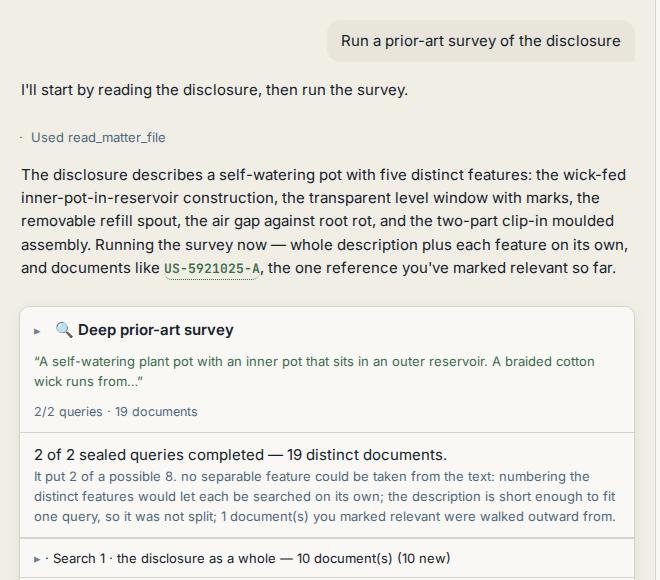
Describe what you built, in your own words. The assistant searches patent publications through a sealed search machine your computer checks first, and gives you the closest earlier patents, your own relevance marks, and a record anyone can verify.
How it goes
Describe. Check. Search. Mark. Export.
- 1
Open a matter and describe the invention
Write what it does and what is new about it, or let the app read a document or repository and draft the matter for you. Your matters are kept in a folder on your computer. Nothing is sent yet.
- 2
Your computer verifies the machine
By remote attestation, the app checks the machine's hardware, and that its software matches the identity InferRoute signed and published. If a check fails, nothing is sent. Then your description is sealed on your computer to that machine and sent.
- 3
The assistant searches
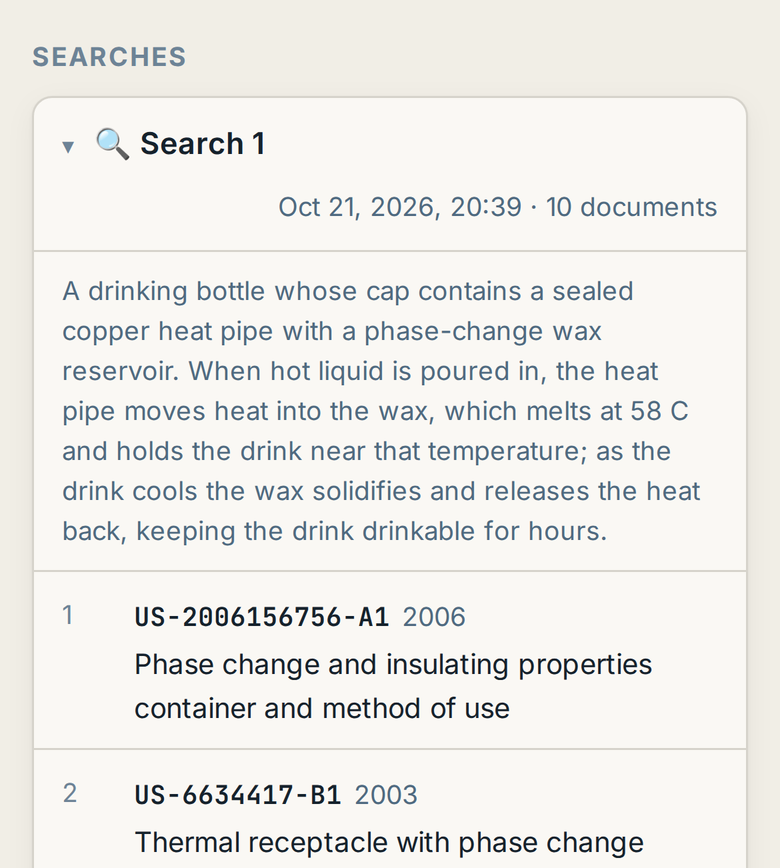
It runs several searches against about 29.6 million US, EP and WO patent publications (titles and abstracts). A single patent search returns in seconds; a whole session, several searches plus the writing, takes minutes.
- 4
You mark what is relevant
Each earlier patent comes with its publication number and year. You mark relevance yourself; the assistant does not decide novelty for you.
- 5
Export the record
A record of the session's searches, with a verifier that ships in it, so anyone can check it without trusting InferRoute.
Coverage
What it searches, stated plainly.
Searched
- About 29.6 million US, European (EP) and WIPO (PCT) patent publications
- Titles and abstracts
- US to 21 April 2026, EP to 15 April 2026, WO to 9 April 2026; US effectively from 1971
- Source: Google Patents Public Data, extracted 1 September 2026; not refreshed since
Not searched
- Full text, claims or descriptions (they are in the corpus but are not searched)
- French national patents; CN, JP, KR, DE or other offices
- Scientific papers, open-source code and other non-patent literature
- Anything published after mid-April 2026
If you build software, the earlier work that matters is often an open-source project or a paper. Anteriora searches patents only, and says so up front. It gives no answer on novelty or freedom to operate; those are questions for a patent attorney.
Read a document or a repository
Let it read what you built.
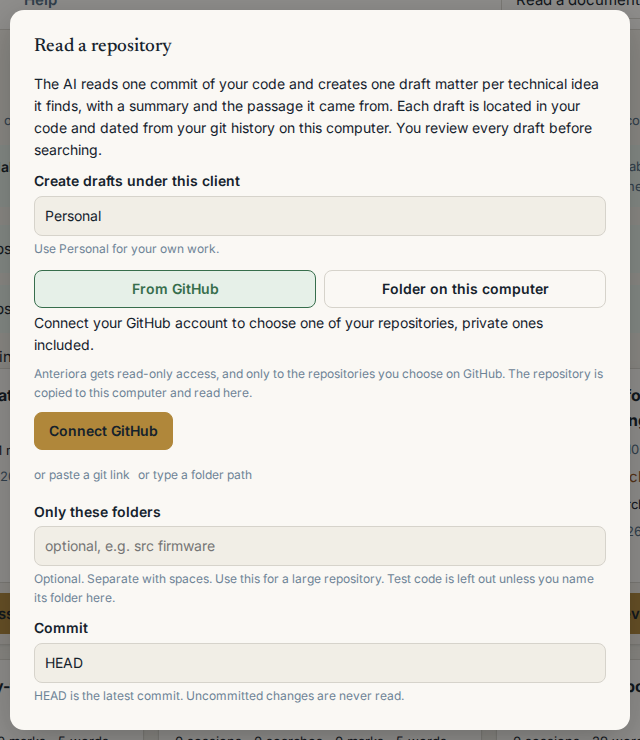
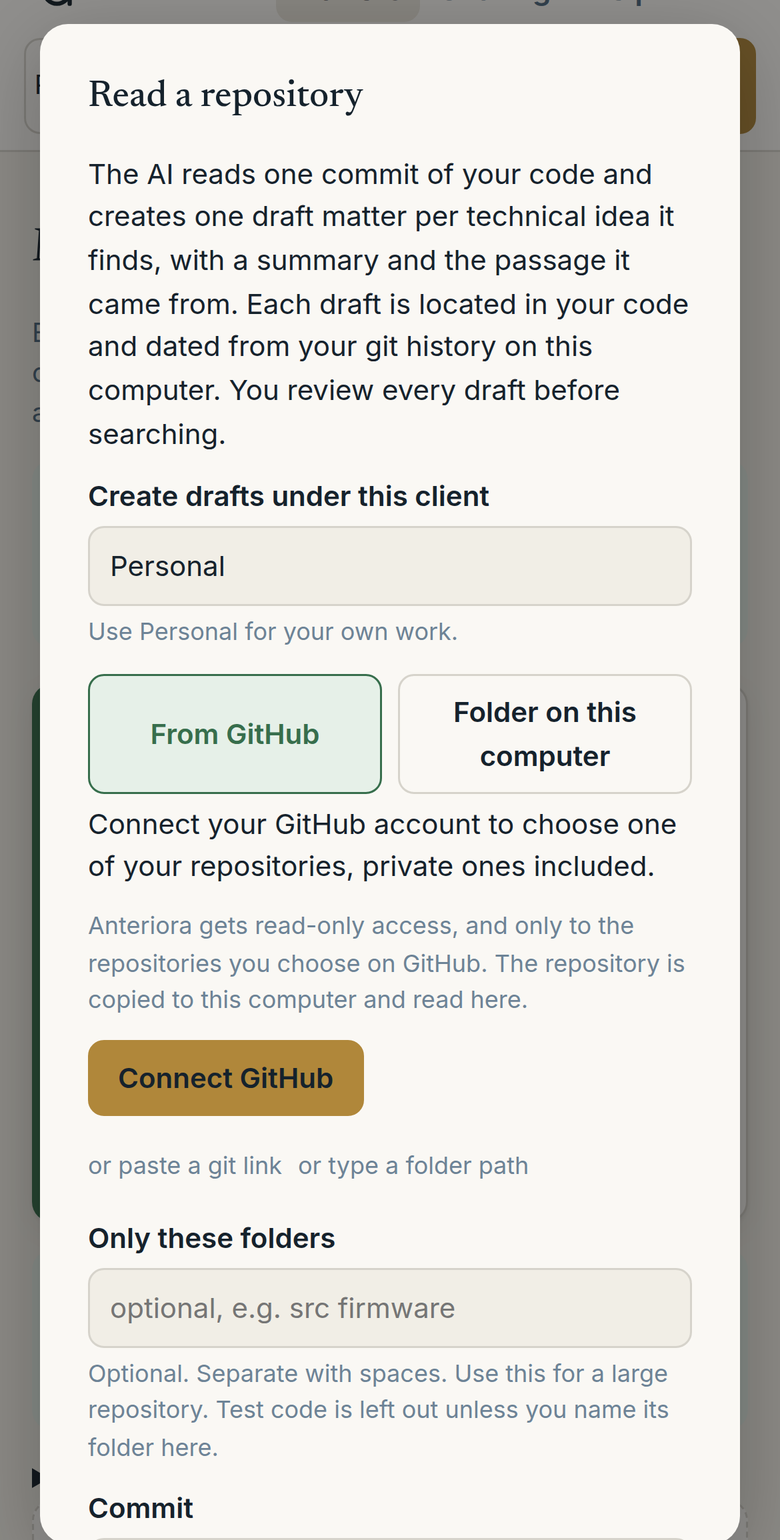
Point it at a document, a folder, a git link or a GitHub repository (read-only access, only to the repositories you choose; the repository is copied to your computer and read there). It lists each distinct invention it finds and writes a draft matter for each, ready for you to edit and survey.
- You choose what it reads; test code can be left out.
- Measured: a 1,700-line repository took about 40 minutes and produced 12 drafts.
- It does not promise to find every invention, does not say whether anything is patentable, and a draft matter is not something ready to file.
Questions
About the survey.
How good is it?
It is a first look by title and abstract, not a complete search. We do not publish a quality number: our held-out test is our own, and it says nothing about your invention in particular. Use the survey to see what exists and to brief an attorney, not to conclude that nothing similar exists.
What does the record contain?
The session's searches and what came back, with a verifier that ships in the record so anyone can check it without trusting InferRoute. It is not a filing and does not establish when you invented something.
Does the assistant decide what is relevant?
No. It finds and lists; you mark relevance. The marks are yours and stay in the matter.
Start
Three steps, about five minutes.
- 1
Create your account
Your first name check is free. Your account gives you an app key.
- 2
Install the app
One command on macOS (Apple silicon) or Ubuntu.
- 3
Open a matter
An invention, a document or repository to read, or names to check.